
Dallam Release Dates by System
No single calculator covers every person associated with Dallam County. The Dallam-Hartley County Jail computes a county sentence from the court judgment, jail credit, the way multiple terms run, and any lawful county good-conduct award. TDCJ Classification and Records computes a state prisoner's projected date. The Federal Bureau of Prisons controls federal sentence calculations. A date from one system must not be carried into another.
Custody status comes first. Someone awaiting trial has an open-ended stay governed by bond, court action, a hold, or transfer. A sentenced person may have a calculable term, but the date can still change. If a Dallam-Hartley record says the person transferred, follow the named receiving agency. A transfer ends local jail custody without proving release to the community.
Check a Dallam Jail Date
For a county-jail term, start with the Dallam-Hartley County Jail and the court file. The jail does not publish a searchable roster, a projected-date tool, or a release archive. Call the official jail line at 806-244-2541 and ask which record custodian can confirm the calculation. Give the full name, date of birth, booking date, and booking or cause number when known.
Next obtain the judgment and any later order from the combined Dallam County and District Clerk. Those documents can show the sentence, jail credit, concurrent or consecutive terms, bond action, modification, or dismissal. The jail's movement record then supplies the operational result. Read them together because the court order may not show the minute of physical release, while a jail timestamp does not explain the full case outcome.
The official Dallam County Sheriff page identifies the sheriff and jail contact routes. The combined County and District Clerk is the practical court-record starting point for Class A and B misdemeanors and felony district matters. Give the clerk the cause number from the booking record whenever possible. That identifier is safer than guessing a court solely from the arrest charge.
- Confirm that the person is held at Dallam-Hartley, not TDCJ or another agency.
- Ask the jail for its current calculation and the source documents used.
- Match the booking or cause number to the clerk's judgment and later orders.
- Ask whether any hold or transfer prevents community release.
- Request the completed release or movement record after the expected date.
The broader Dallam County released-inmate search explains how to reconcile a jail event with the court file when a person is no longer in local custody.
Dallam TDCJ Release-Date Search
The official TDCJ Online Inmate Search is useful only while TDCJ currently incarcerates the person. Search by the seven-digit TDCJ number or SID number when possible. Otherwise, use the exact last name and at least a first initial, then compare identity, offense, county, and unit fields before relying on any date. TDCJ says the site updates on working days and may be at least a day behind.
Open the detail and copy the field label exactly. “Projected Release Date,” “Parole Eligibility Date,” and “Maximum Sentence Date” do not mean the same thing. The projected field estimates when the person may leave if parole does not occur sooner. Eligibility only opens review. Maximum expiration marks the end of the sentence calculation, subject to the governing record.
The manifest image below comes from the official TDCJ search and shows the identifiers offered on its search form.
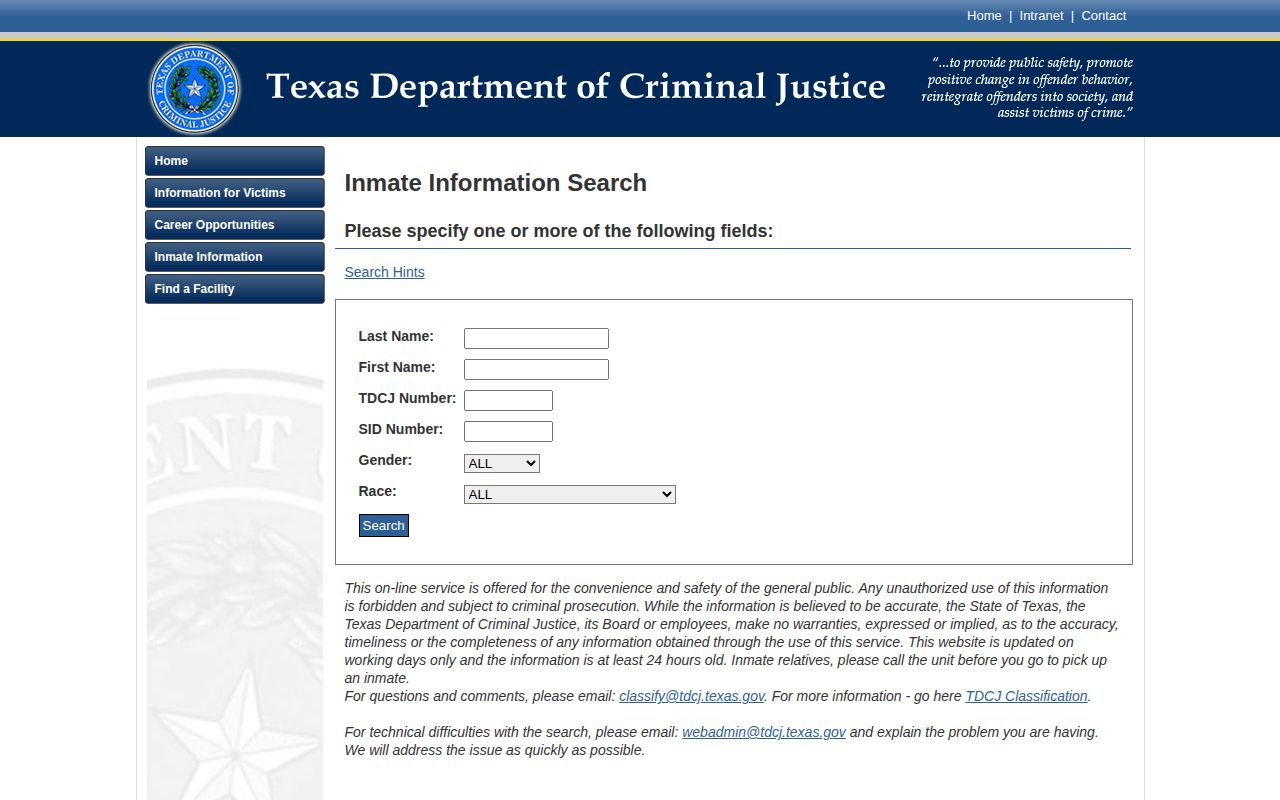
The interface is a current-prisoner tool, not a released-person archive. Once a former prisoner disappears from results, a no-result does not establish the release date.
| Field | What it answers |
|---|---|
| Projected Release Date | TDCJ's current forecast if parole does not occur sooner. |
| Parole Eligibility Date | When review may become possible, not a promised exit. |
| Maximum Sentence Date | The sentence endpoint shown in the current calculation. |
| Unit and offense | Identity and case context needed to avoid a false match. |
Texas Release-Date Rules
Texas has no general rule that every state prisoner serves 85 percent. Under Government Code §508.145, the ordinary eligible framework generally reaches parole eligibility when calendar time plus good-conduct time equals one-fourth of the sentence or 15 years, whichever is less. Listed serious offenses and affirmative deadly-weapon cases generally use actual calendar time equal to one-half of the sentence or 30 years, whichever is less, without good time, and require at least two calendar years. Other offense-specific provisions also apply.
Eligibility is not release. It permits consideration by the Texas Board of Pardons and Paroles. Government Code Chapter 498 governs TDCJ good-conduct time, classification, diligent-participation credit, forfeiture, and possible restoration. Those credits do not erase the court's sentence. The offense date, judgment, classification, conduct record, and precise statutory category all matter.
Mandatory supervision is separate. Sections 508.147 and 508.149 exclude some cases and permit denial in others. For eligible cases from the older statutory period, flat time plus good time can produce a scheduled date. In later discretionary cases, a Board denial can move the projected field to maximum expiration. A later approval may move it earlier again while staff complete release processing.
Note: A generic percentage calculator cannot replace the official TDCJ computation or a case-specific reading of the judgment.
Dallam County Good-Time Credit
A Dallam county-jail sentence uses a different law. Texas Code of Criminal Procedure Article 42.032 permits a sheriff to grant commutation, or sentence reduction, for good conduct, industry, and obedience. The authorized amount may not exceed one day for each day of the original sentence actually served, and misconduct can affect the award. This is discretionary county authority, not the TDCJ classification formula.
That rule does not support a public guess about a specific person's date. The calculation still needs the signed judgment, credit already awarded, any consecutive or concurrent sentence terms, local classification, and the sheriff's actual determination. Ask the Dallam-Hartley custodian for the maintained calculation rather than subtracting days from a sentence seen on a docket.
Why Texas Projected Dates Move
Dallam-related TDCJ cases can show a projected field that shifts between an earlier mandatory-supervision estimate and maximum expiration. This is the specific Texas quirk highlighted by the official TDCJ definitions. A discretionary mandatory-supervision denial may push the field later. A subsequent approval may move it forward again. Neither display proves that release staff have completed the plan, conditions, certificate, and physical exit.
Parole has its own sequence. A favorable Board vote is followed by Review and Release Processing, which checks the proposed plan, county-of-residence rules, discipline, required programs, and special conditions. A vote code or expected month therefore cannot be reported as an actual release.
| Change | Possible effect |
|---|---|
| Good-time forfeiture or restoration | Changes credit used in an applicable state calculation. |
| Board action | May deny, approve, withdraw, or reschedule a release path. |
| New judgment or recalculation | Can alter sentence credit, offense treatment, or term order. |
| Detainer or agency hold | May cause transfer instead of community release. |
| Release-plan processing | Can delay physical release after a favorable decision. |
Confirm Dallam Actual Release
When a person no longer appears in the TDCJ web search, stop using the last saved projected date as proof. TDCJ expressly limits public web results to current prisoners. The agency's inmate-information email and telephone routes can help identify the right record, while a formal Public Information Act request can seek an existing actual release or discharge date, release type, certificate, or sentence history.
Use Parole Division or TDCJ IVSS if supervision or notifications apply, then compare the court judgment. For a federal sentence, use the BOP locator and federal docket. For a local jail episode, return to Dallam-Hartley's release or movement record. The current VINE inmate check options can supply alerts, but an alert never replaces the originating agency's record.
- Projected date
- A conditional agency forecast.
- Parole eligibility
- The first point at which review may be available.
- Discharge
- Completion of incarceration or supervision, depending on the field.
- Detainer
- A request or hold tied to another authority that may lead to transfer.
Request Dallam Release-Date Records
When telephone information cannot settle the date, request the existing records. Dallam County's open-records notice routes a request to the elected official or department head that maintains the material. For a local jail episode, identify the full name, aliases, date of birth, approximate booking date, arresting agency, booking number, and cause number. Ask for the booking sheet, sentence calculation if maintained, movement history, release date and time, release type, destination on transfer, holds, and the source order.
Keep the request narrow. Texas Government Code Chapter 552 applies to existing governmental information, but it does not require staff to answer a new question or build a custom release forecast. Ask for electronic copies and a written cost estimate when needed. State rules do not promise that every request will be completed within ten business days. If production will take longer, §552.221 requires a reasonable availability date.
For TDCJ material, use the agency's designated public-information route instead of sending the request to Dallam County. Ask for the actual release or discharge date, release type, release certificate, or sentence-discharge history that exists for the named person. For BOP material, begin with the locator and use federal records procedures if the published history is incomplete.
TDCJ also maintains separate telephone routes for different stages. The general inmate locator can address present placement. The Board status line concerns parole review, while the Parole Division release-status line applies after a favorable vote and requires a TDCJ or SID number or a date of birth. These channels should not be merged. A favorable decision still leaves release-plan review, conditions, required programs, and certificate processing to complete. Check the official TDCJ telephone-information page before calling because agency routing can change.
Conflicting dates should remain distinct until the responsible office explains them. A court order date, a TDCJ projected field, a notification timestamp, and the time of physical departure can all describe different events. Preserve each label and the date checked. The actual release record from the agency that completed the event carries the most direct operational proof.